As a 72-year-old, African-American and SeasonedSistah, I write this post to share current thoughts and past memories about Police Brutality after reading The Seeker’s Dungeon Prompt:
“In many countries where guns are not legal the police also don’t carry guns themselves — only the military does. In America because guns are so widespread, we couldn’t even conceptualize an unarmed police force. But now, with the full militarization of the police, do you think it has gone too far? Do you feel scared when you see the cop strapping a gun while waiting for coffee in line next to you at the Starbucks? What is your relationship with the police and how do you think your race has colored that? Has race colored your perception of police brutality.”
CURRENT THOUGHTS
Full militarization of police departments
In my lifetime, an unarmed police force is highly unlikely; but, I do feel the militarization of police departments diminishes our perception that they are here to serve and protect us.
Do you feel scared when you see the cop strapping a gun while waiting for coffee in line next to you at the Starbucks?
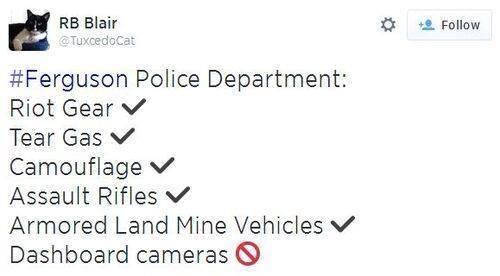
My own fear and distrust of police escalated when I viewed the television news footage of the police descending on Ferguson, Missouri:

After viewing this, I was left with the impression that the police officer’s role has changed from “protect and serve” to “fight and battle.”
However, I don’t personally feel threatened when I see a police officer carrying a holstered gun. Because, my age bracket, 72, does not meet their racial profiling protocol. At least, I believe this is the case.
What is your relationship with the police and how do you think your race has colored that.
After, the many questionable killings of African-American men by police officers throughout the country, I fear for my son and three grandsons if they were to have an encounter with the police.
PAST MEMORIES
Full militarization of police departments
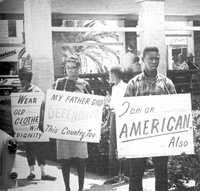
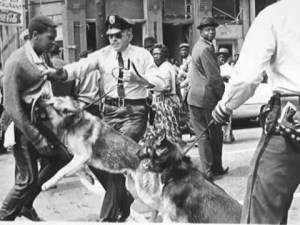
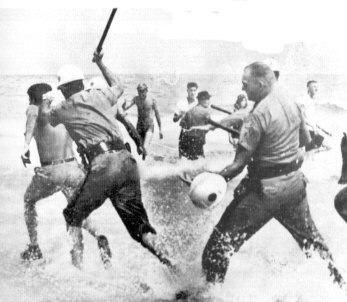
In the South, during the Civil Rights Movement, the police did not have militarized equipment. On television, I watched law enforcement officers approach peaceful protesters with looks of hate on their faces to “fight and battle” the enemies. Their purpose in being there was definitely not to “protect and serve” the non-violent protesters in their fight to gain equal rights for African-Americans in America.

Do you feel scared when you see the cop strapping a gun while waiting for coffee in line next to you at the Starbucks?
As a child, I feared law enforcement officers, especially in the South. This stemmed from listening to my elders tell stories about racist and inhumane acts against African-Americans perpetrated by law enforcement officers in Mississippi.
It was this fear that caused many African-Americans to drive at night when traveling in the South. They didn’t want to meet law enforcement officers on the highway or in small towns. The common belief was that law enforcement officers targeted African-American travelers in newer automobiles with northern license plates. And, when stopped, they faced trumped-up charges, heavy fines, racial harassment, beatings; and, sometimes even jail sentences.
What is your relationship with the police and how do you think your race has colored that?
In 1978, my father’s death was ruled a suicide based on information provided by a police officer and his brother who said they saw the suicide.
This is the real story, as reported years later on January 24, 2007, in the Chicago Reader titled “The Good Cop – Frank Laverty.
The author, John Conroy, describes Detective Laverty, as the “Chicago police detective, who did the right things and paid for it for years.”
It’s an eight-page article, but several paragraphs are about Detective Laverty’s investigation of my father’s death:
“One summer morning in 1978 Laverty was ordered to notify the family of Hamp Burks, a janitor, had committed suicide the night before in a tavern on 103rd Street, The paperwork, written by an Area Two detective, said Burks had grabbed the gun of Chicago police sergeant Henry Cooper, who was also in the bar, and shot himself in the head. “I don’t know why the midnight crew can’t make their own damn notifications.” Laverty told me, “but I went over to make the notifications by myself.”
Laverty, however, also dropped by the tavern. He found witnesses who said the sergeant, a 25-year veteran whose brother owned the place, had executed the janitor. At first Laverty thought the suicide report must have been a mistake made by a detective who didn’t know better, but he later concluded that the detective had given the sergeant a pass. “I locked (Cooper) up,” he said, “It was hard to make it stick.”
Cooper was convicted in January 1980 and sentenced to 20 years. Not long after Laverty was looking at a homicide victim in a hospital when a sergeant told him he wished it was Laverty on the slab, “because I locked up Henry Cooper and he was their favorite. He was the corruption king of the Fifth District.” Laverty realized he’d made enemies he didn’t know.
I was estranged from my father at the time of his death. Along with my stepbrother, we made the funeral arrangements. And, I left Chicago immediately after his burial. At the time, I chose not to receive information during the investigation; but I was informed when Mr. Cooper was found guilty and sentenced to twenty years.
Mr. Cooper was an African-American and Detective Frank Laverty an Irish American. On one hand, Mr. Cooper relied on the code of silence to save him from a murder charge. And on the other, Detective Laverty broke the code of silence and did the right thing.
Today, as in the past, I do not trust the police to do the right thing.
I believe, many police officers bring racial bias and hatred into the workplace, including some who are African-Americans.
Also, I believe, like Detective Laverty, there are police officers who, philosophically, do not agree with this code of silence; but, unlike Detective Laverty, they lack the courage to break the code.





 SeasonedSistah